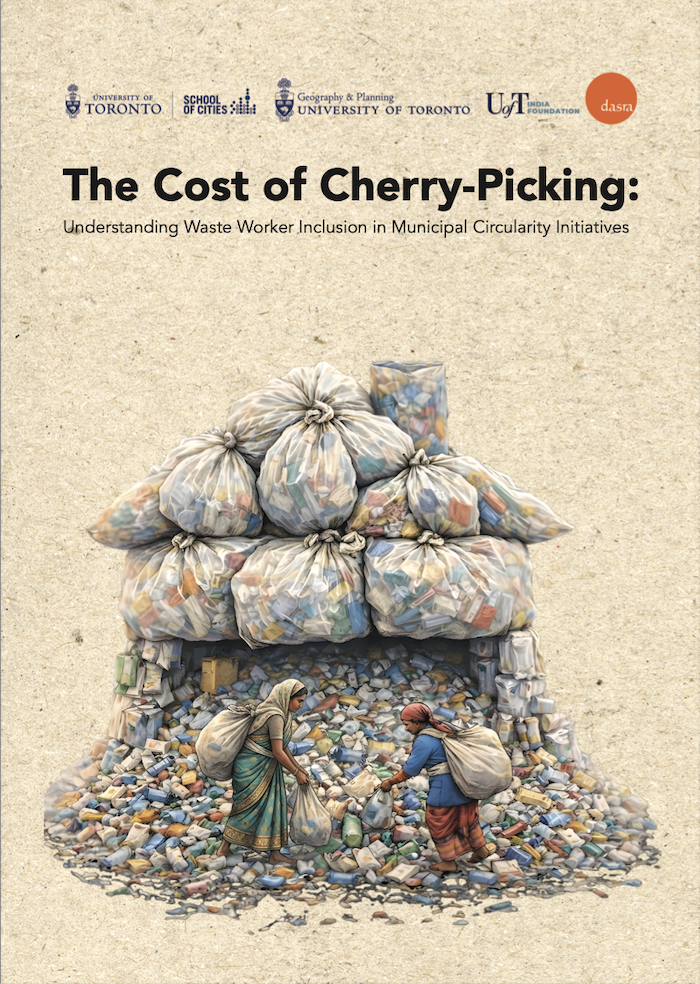
India’s residential waste systems rely on an estimated four million informal workers whose labor enables recycling, material recovery, and landfill diversion. Yet even as cities increasingly adopt the language of circularity and sustainability, the workers who sustain these systems remain marginal to how transitions are designed, governed, and financed. Based on field research in Bengaluru, Bhubaneswar, and Goa, this study examines how informal waste workers are recognized, integrated, and protected within emerging urban waste systems. It finds that while inclusion has expanded in recent years, it remains partial, fragile, and deeply uneven.
Across cities, formalization has largely produced visibility without security. Workers may receive ID cards, uniforms, or assigned municipal roles, but these rarely translate into long-term protection or meaningful authority over waste governance. Waste workers continue to experience:
- Low and delayed wages
- Dependence on informal debt and side work
- Hazardous exposure and chronic health risks
- Unsafe living and working conditions
- Intergenerational occupational concentration shaped by caste and migration
Systems appear stable because workers, households, and intermediaries absorb the pressures and risks that institutions fail to address.
The research shows that current circularity transitions remain overwhelmingly oriented toward infrastructure, compliance, and material efficiency. Municipal contracts reward tonnage moved rather than recovery, worker safety, or ecological outcomes. Labor is treated as operational input rather than as the foundation on which circularity depends. Key systemic gaps include:
- Inclusion that improves visibility but not protection
- Circularity frameworks focused on materials rather than labor systems
- Gender-responsive initiatives that remain programmatic instead of structural
- Under-recognition of community-based governance models
- Incentives that prioritize waste volume over sustainability
The study identifies three intersecting lenses through which these dynamics unfold: institutional arrangements, socio-economic realities, and policy and regulatory systems. Together, they reveal that worker integration is negotiated and contested rather than secure. The findings show that:
- Formalization often creates precarious stability rather than secure inclusion
- Responsibility is transferred to workers faster than decision-making power
- Community-based systems improve accountability but remain financially fragile
- Women workers remain concentrated in lower-paid and lower-protection roles
One of the study’s central findings is the critical role played by intermediaries such as unions, nonprofits, collectives, and social enterprises. These actors perform essential “repair work”: helping workers secure documents, navigate welfare systems, manage payment delays, maintain continuity during contractor transitions, and negotiate access to waste. This labor remains underfunded despite being central to the functioning of urban waste systems.
The report argues that a just circular transition cannot be built solely around materials, infrastructure, or efficiency metrics. It requires reorienting system design around labor dignity, worker protection, and shared responsibility. Strategic priorities include embedding labor safeguards into contracts, funding intermediary organizations as governance actors, strengthening worker agency, and investing in occupational health and intergenerational mobility.
India’s waste systems are not unorganized; they are highly ordered around performance without protection. The challenge ahead is whether circularity transitions will continue to depend on the endurance of marginalized workers, or whether they can be redesigned around equity, and security.


 Research Reports