

Solid waste affects everyone at an individual, community and public level.
With India’s per capita, per day waste generation estimated at 0.6 kg, and notwithstanding industrial solid waste generation, solid waste management (SWM) is a daily million-ton problem for India – and it is projected to increase.
As we try to make good on economic goals – India’s demographic, migratory, consumption and waste patterns are changing. India continues to urbanize, and its cities face compounding challenges in waste management due to increasing population, limited space, overburdened systems, and vast socio-economic disparities.
Amidst rapid urbanization, only 26% of urban areas are covered by waste management systems deployed by municipal bodies.
The cascading effects of this gap are for all to see – openly dumped garbage, waste mountains in decades-old landfills, polluted land and waterbodies, breakdown in public health, and stagnating neighborhoods.
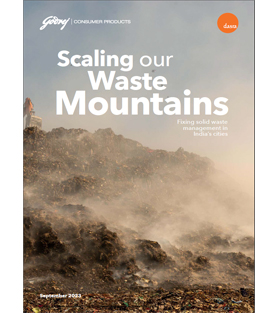
This report takes a deep dive into solid waste management in India’s cities, with a focus on the human dimension of SWM, and the roles and challenges of three of these actors: Urban Local Bodies, Informal Waste Workers, and Citizens.
At the frontier of this problem is a diverse ecosystem, composed of various formal and informal actors, including:
We find that while their challenges are tied to hyper local contexts, there are some universal linkages in their experience of Solid Waste Management
Beyond these three stakeholders, we have also looked at and amplified the pathbreaking work of NGOs whose interventions have solved for several intersecting challenges in SWM, from the individual to the community, and more broadly the local – affecting lasting change and quantum leaps in quality of life, livelihoods, public health and wellbeing, and greater environmental health.
|
|
ROLE IN SWM
|
CHALLENGES |
INTERVENTIONS |
|
URBAN LOCAL BODIES
|
»Preparation of SWM Plans »Primary & secondary municipal waste collection/ transport »Street sweeping and drain cleaning »Treatment & disposal »Information, education and communication to influence behavior change
|
» Lack of source segregation »Difficulty in creating awareness, changing attitudes, behavior and habits »Occupational hazards »Barriers to regular and accurate documentation »Urbanization, density in settlements and lack of real estate |
»Providing capacity building, project management and personnel support for ULBs »Setting up replicable SWM implementation models »Facilitating public private partnerships and targeted financing models |
|
INFORMAL WASTE WORKERS |
»Collection of waste from households, industries, streets, waterways, dumps, and landfills »Sorting and segregation »Reducing environmental harm »Driving economic growth »Supporting recycling industry |
» Intergenerational poverty burden »Social perceptions and discrimination »Financial structures »Power dynamics with scrap dealers »Access to education »Working Conditions and Health »Developing threats »Gender dynamics |
»Collectivizing to upskill informal waste workers through membership models »Enabling social security, formalization, and integration of informal waste workers »Addressing the health and wellbeing needs of informal waste workers |
|
CITIZENS |
»Household recycling »Traditional upcycling »Source segregation & composting »Paying for waste management services |
» Limited capacity/resources to segregate waste at home, especially in under resourced communities » Limited awareness about solid waste materials, their subcategories, and disposal guidelines » Lack of agency over their habitats and the waste in them |
»Using communications as a tool to improve citizen awareness of SWM »Creating opportunities for volunteering and cleaning up habitats »Promoting source segregation through residential composting and neighborhood regeneration programs |
Based on our research, key cornerstones that can support such interventions and stakeholders are:
As we grapple with our own consumption and waste practices, it is vital to understand our local SWM systems, the humans behind these systems, and our role in the transformations we wish to see. While waste mountains represent several inconvenient truths about cities, we need to come together to get the wheels of true, just, and sustainable circularity turning. This report concludes with the following recommendations:
For State and Civil Society
For Citizens
For Funders
 Case Studies
Environment, Biodiversity, Conservation, and Climate
Research Reports
Environment, Biodiversity, Conservation, and Climate
 Research Reports
Environment, Biodiversity, Conservation, and Climate, Gender Empowerment
 Research Reports
Child Protection and Youth Development, Environment, Biodiversity, Conservation, and Climate



Explore 25+ years of Dasra's research and knowledge products, covering underserved sectors, philanthropy trends, and civil society action across India.