

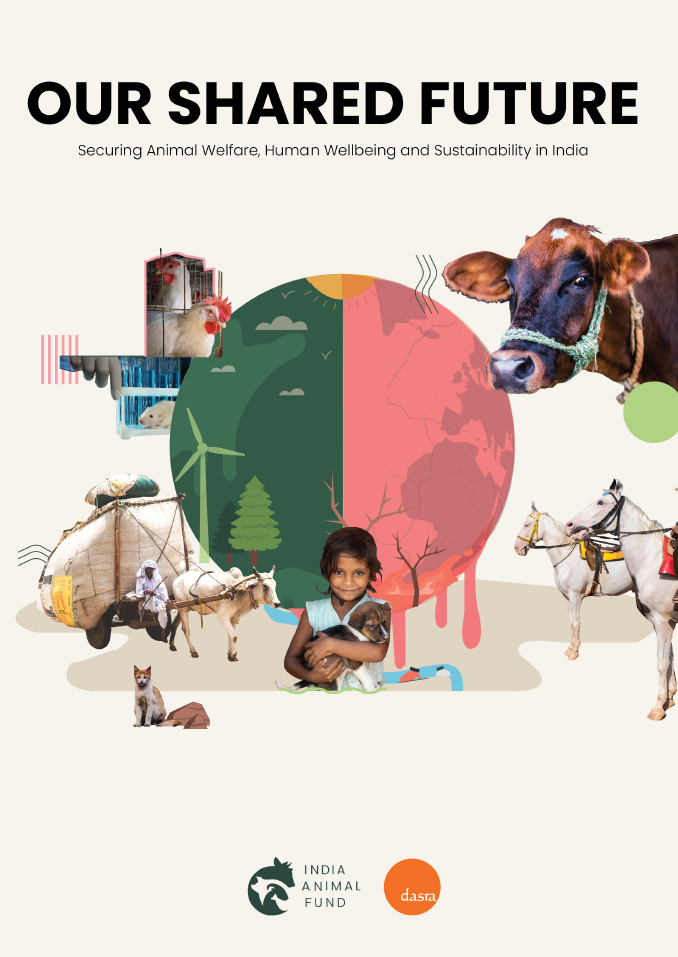
India has long imagined itself as a civilization shaped by coexistence, where animals have occupied spaces of reverence, companionship, labour, and cultural significance. Yet beneath this inherited ethic lies a growing contradiction. Across food systems, urban ecosystems, research settings, entertainment industries, and informal economies, animals today are increasingly caught within extractive and intensive systems that prioritize productivity over wellbeing.
The consequences of this are often framed narrowly as questions of animal suffering. This report argues for a broader view. Animal welfare is not a peripheral ethical concern; it is deeply intertwined with public health, ecological resilience, economic justice, and human wellbeing. The ways in which we treat animals shape the systems that sustain us all.
Nowhere is this interdependence more visible than in public health. Industrial animal agriculture has become a significant driver of antibiotic resistance, as the routine use of antibiotics in feed accelerates the emergence of drug-resistant pathogens. This is not a distant threat. It is a mounting global crisis with profound implications for human survival. Intensive animal systems also heighten the risk of zoonotic disease transmission, creating conditions where pathogens can move rapidly between animals and humans. The COVID-19 pandemic underscored the costs of underestimating these linkages.
Closer to home, harmful production practices carry direct consequences for human health. The misuse of substances such as oxytocin in dairy production not only compromises animal welfare but also raises serious concerns about downstream effects on human consumers. These practices reveal how exploitative systems rarely harm animals alone; they produce cascading risks across the broader public health ecosystem.
The environmental costs are equally stark. Animal agriculture is a major contributor to greenhouse gas emissions and a significant driver of land degradation, deforestation, freshwater depletion, and pollution. These impacts extend beyond abstract climate metrics. They shape local ecologies, disrupt biodiversity, contaminate shared natural resources, and intensify vulnerability for communities already on the frontlines of environmental stress.
Yet these harms are not distributed evenly. Those most closely embedded in animal-dependent economies, involving smallholder farmers, informal workers, transporters, slaughterhouse labourers, and others in precarious livelihoods, who often bear disproportionate costs. They are frequently blamed for practices produced by larger structural incentives, while receiving little support to transition toward safer, more sustainable systems. Occupational hazards, economic insecurity, and exposure to unsafe working conditions remain endemic across many sectors linked to animal use.
There are social and psychological consequences too. Exposure to normalized violence against animals has been linked to broader patterns of trauma, desensitization, and mental distress. Workers in high-intensity slaughter environments often experience profound psychological strain, while evidence increasingly points to connections between animal cruelty and wider cycles of interpersonal violence.
At its core, this is also a question of resource justice. Animal agriculture consumes vast land, water, and feed inputs while producing disproportionately limited nutritional returns relative to the resources it demands. In a country grappling with food insecurity, water stress, and competing developmental priorities, these inefficiencies demand urgent scrutiny.
The pathway forward is not singular, nor is it simplistic. Greater animal welfare in India requires a systemic transition: reducing unnecessary dependence on animal products, accelerating alternatives, improving welfare standards where animal use persists, and strengthening rehabilitation systems that restore animals to safer environments wherever possible.
This transition will depend on four catalytic levers.
First, awareness: cultivating a more nuanced public understanding of animal welfare as a systems issue rather than a niche concern. Second, capital: directing financial resources toward research, innovation, and grassroots implementation. Third, talent: building a pipeline of practitioners, researchers, and advocates equipped to shape this field. And fourth, policymaking: advancing evidence-based reform that reflects India’s social, economic, and ecological realities.
No single actor can drive this shift alone. Philanthropy must catalyze long-term systems change. Corporates must embed welfare into sustainability commitments. Civil society must continue to generate context-specific evidence and accountability. Governments must create enabling regulatory environments. Citizens, too, have a role to play through more conscious consumption and community stewardship.
Ultimately, animal welfare is not about choosing between human progress and compassion. It is about recognizing that the two are inseparable. The future of sustainability in India will depend, in no small measure, on whether we can reimagine our relationship with animals as integral participants in the shared ecosystems on which all life depends.
 Case Studies
Environment, Biodiversity, Conservation, and Climate
 Research Reports
Environment, Biodiversity, Conservation, and Climate
 Research Reports
Environment, Biodiversity, Conservation, and Climate, Gender Empowerment
 Research Reports
Child Protection and Youth Development, Environment, Biodiversity, Conservation, and Climate



Explore 25+ years of Dasra's research and knowledge products, covering underserved sectors, philanthropy trends, and civil society action across India.