

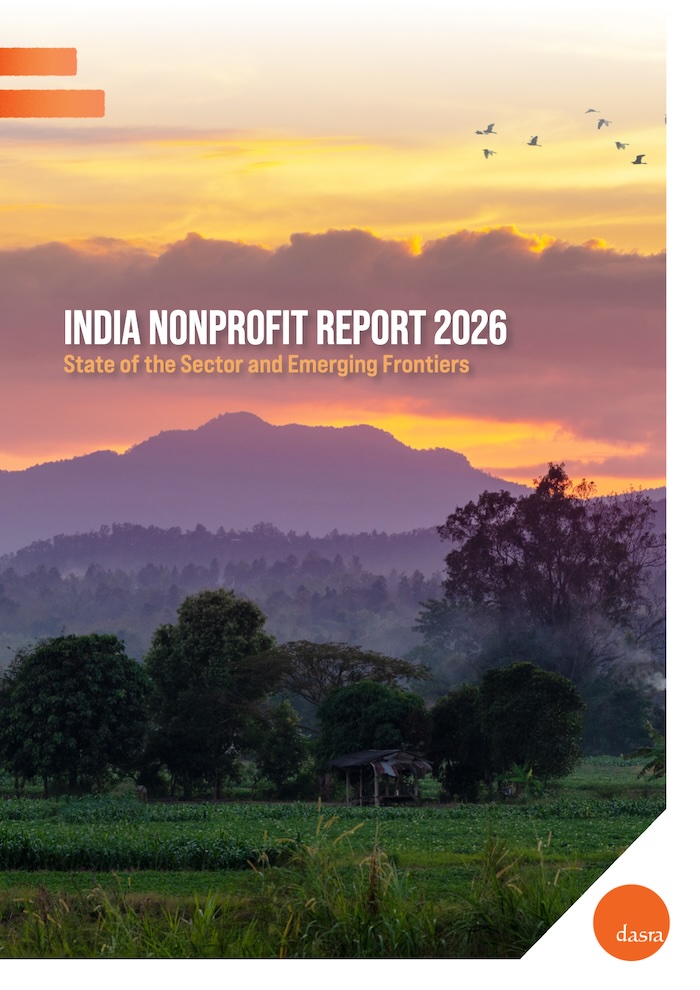
India Nonprofit Report 2026
India's nonprofit sector, comprising 515,000+ registered organizations, 16 million employees, and INR 11.3 trillion deployed in FY24 (by religious and charitable entities), is one of the largest organized civil societies in the world. This report, based on a survey of 438 nonprofits and 25+ expert interviews, captures the expanse and operational realities of the sector, and the journeys organizations are taking to fulfil their mission.
The scale of India's development progress sets the context.
The country's SDG score reached 66.9 in 2025, a 12-point gain since 2015 and one of the fastest trajectories among large emerging economies, with 400 million people lifted from extreme poverty since 2005. Public social sector spending is projected to reach INR 50 lakh crore by FY30, growing at 13% annually; the state provides direction and capital, while civil society translates it to last-mile outcomes. Yet India's HDI of 0.68 remains well below the OECD average, and gains from growth remain unevenly distributed. The sector's own density reflects this: 42 registered nonprofits per lakh population, against 441 in the United States. Registrations have grown despite a constrained funding environment, but geographic and thematic concentration persists. 46% of nonprofits are in Southern and Western India, with limited presence in Eastern and Central India. Legacy sectors like Education, Health, and Gender draw the heaviest organizational presence, while areas like Animal Welfare and Prisoner Issues remain underserved.
The organizations closest to the grassroots are experienced, embedded, and under-resourced.
Based on our pan-India survey of 438 nonprofits, 80% respondents are micro or small, operating on budgets under INR 3 crore; 72% have been operational for over a decade; and 92% work in rural or mixed settings. Yet 68% reported a funding deficit in FY 2024–25, rising to 83% among micro-organizations, and 73% nonprofits have no corpus fund. 90% cite funding and financial sustainability as their primary challenge. Funding architecture for an organization also relates strongly to its size. Retail giving meets direct project costs; CSR, rising from 15% at micro to 49% at large organizations, funds proof of concept; private domestic capital fits institution building; and government grants, peaking at small organizations and nearly absent at large ones, point to an underutilized role in enabling environments. Beyond funding, institution building remains a binding challenge, tightening precisely when organizations are positioned to grow. Inclusion at the leadership level represents a mixed picture: 91% of surveyed organizations have women in senior leadership, yet around 60% of large and very large organizations have no leadership representation from any marginalized community, a gap that widens for larger organizations.
How organizations scale is not uniform, and the pattern matters.
Micro and small organizations scale deep, working hyperlocal and navigating complexity that wider programs cannot absorb. Medium organizations also scale deep but form the sector's proof layer, generating evidence and building replicable models. Large and very large organizations scale across and work at the level of systems and policy, expanding reach and anchoring public accountability. These functions constitute a chain: grassroots evidence feeds documented proof, and proof informs systems change.
The sector is also actively adapting to new and emerging frontiers.
64% of nonprofits engage in narrative building, 75% work toward systems change, and 59% engage in meaningful collaborative action. COVID-era partnerships have translated into sustained multi-stakeholder initiatives, and organizations are increasingly working across sectoral boundaries to address problems that no single institution can resolve alone.
The report closes with three recommendations for philanthropy: redefine excellence in the nonprofit ecosystem, fund the system rather than the organization, and commit to long-term partnership over project funding. These are nodes in a single system, and social impact requires patient capital to hold it together.
 Research Reports
Strategic Philanthropy
 Research Reports
Strategic Philanthropy



Explore 25+ years of Dasra's research and knowledge products, covering underserved sectors, philanthropy trends, and civil society action across India.