

Cities are centers for economic growth, critical to the vision for a Viksit Bharat 2047. At the cusp of this incredible vision, we must plan for the future to build resilient cities for all our citizens.
Urbanization has crossed an irreversible threshold. More people are living in cities than ever before since the early 2010s. This ongoing urban fold (estimated at three million more joining weekly) signifies that the city is no longer a mere backdrop but the main stage of human life, shaping ambitions, anxieties, inventions, and inequities globally and in India.
City resilience in India is more than shock absorption. It is about a city’s ability to serve its most vulnerable populations. This is because shocks and stresses are often chronic structural vulnerabilities, embedded in daily existence, rather than just sudden disruptions.
City resilience must be understood as an interconnected systems challenge across four foundational pillars.
Climate change significantly exacerbates existing urban vulnerabilities. Increased frequency and intensity of events like heatwaves and floods disproportionately affect the urban poor, impacting their residential conditions, occupational stability (e.g., outdoor workers losing wages), and health outcomes due to fragile systems and inadequate infrastructure.
Municipalities hold a critical, yet often constrained, role in building city resilience. Despite being the closest tier of government to people, their effectiveness is undermined by limited empowerment, low fiscal autonomy, and inadequate technical capacity and human resources, hindering their ability to respond swiftly to local needs.
Indian cities are vibrant spaces of adaptation and innovation. Despite simultaneously confronting significant challenges – Indian cities have exhibited good practices rising from collaborative action, with stewardship by local actors. This report highlights several such good practices from India.
Leveraging ‘futures thinking’ into urban planning can help provide strategic foresight, unlocking transformative and responsive solutions for building resilient cities.
Actionable solutions will emerge from collaborative efforts across all four interconnected pillars, emphasizing shared purpose among government, philanthropy, civil society, private sector, and citizens.
|
|
City Councilors |
Philanthropy |
|
Socio-Economic Resilience: A city that accounts for various vulnerabilities, recognizes the importance of livelihoods, and prioritizes healthcare and education |
Consider using vulnerability maps and service assessments to guide budgets, institutionalize inclusive ward committees, and make social resilience a standing governance priority |
Support digital access to services for vulnerable groups and co-develop tools with cities for mapping needs and delivering welfare
|
|
Infrastructural Resilience: A city that is designed for human centered living, embraces sustainable mobility, and one that prioritizes a circular economy with robust waste management and sanitation |
Consider forming ward committees to assess new projects through a resilience lens and explore collaborations for local composting and greywater recycling solutions |
Invest in underserved areas such as climate-resilient sanitation and waste systems in smaller cities, and support coalitions that unite laborers, local governments, and service providers
|
|
Institutional Resilience: A city that has an empowered urban local body, inter-departmental coordination, and recognizes itself as a custodian of resilience |
Consider tapping into innovative financing like green bonds to fund resilience, and partner with local groups to co-create ward-level plans |
Build open data and participatory governance platforms, while funding technical assistance and pooled investments to tackle systemic urban challenges
|
|
Environmental Resilience: A city that safeguards its natural systems, intentionally invests in nature-based solutions, uses data to monitor and protect its environment |
Consider advocating for integrated planning through cross-departmental teams and institutionalize taskforces to preserve urban commons, allocating some ward funds for community-led green infrastructure pilots |
Bolster technical capacity in smaller cities to use data for climate planning, and prioritize funding ecological restoration in under- resourced peri-urban areas |
Building urban resilience requires empowering frontline leaders with the tools, networks, and narratives. Three interlocking approaches that can catalyze change are:
Resilient urban futures are an ethical proposition as much as a technical one – where cities are engines of shared resilience. It demands that resilience no longer be treated as an exercise in disaster response but as a civic responsibility, a commitment to designing cities that serve the complex, dynamic realities of the many, not the few.
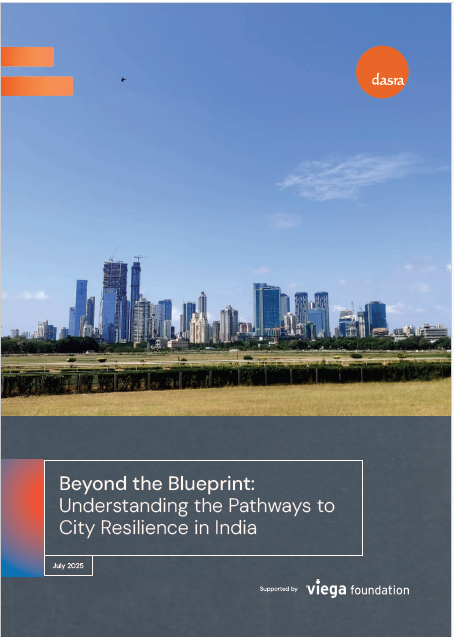
 Research Reports
Environment, Biodiversity, Conservation, and Climate, Urban Planning

 Playbooks & Toolkits
Urban Planning, Water and Sanitation
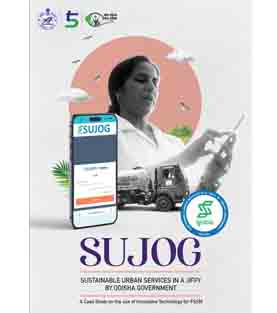 Case Studies
Environment, Biodiversity, Conservation, and Climate, Urban Planning



Explore 25+ years of Dasra's research and knowledge products, covering underserved sectors, philanthropy trends, and civil society action across India.