
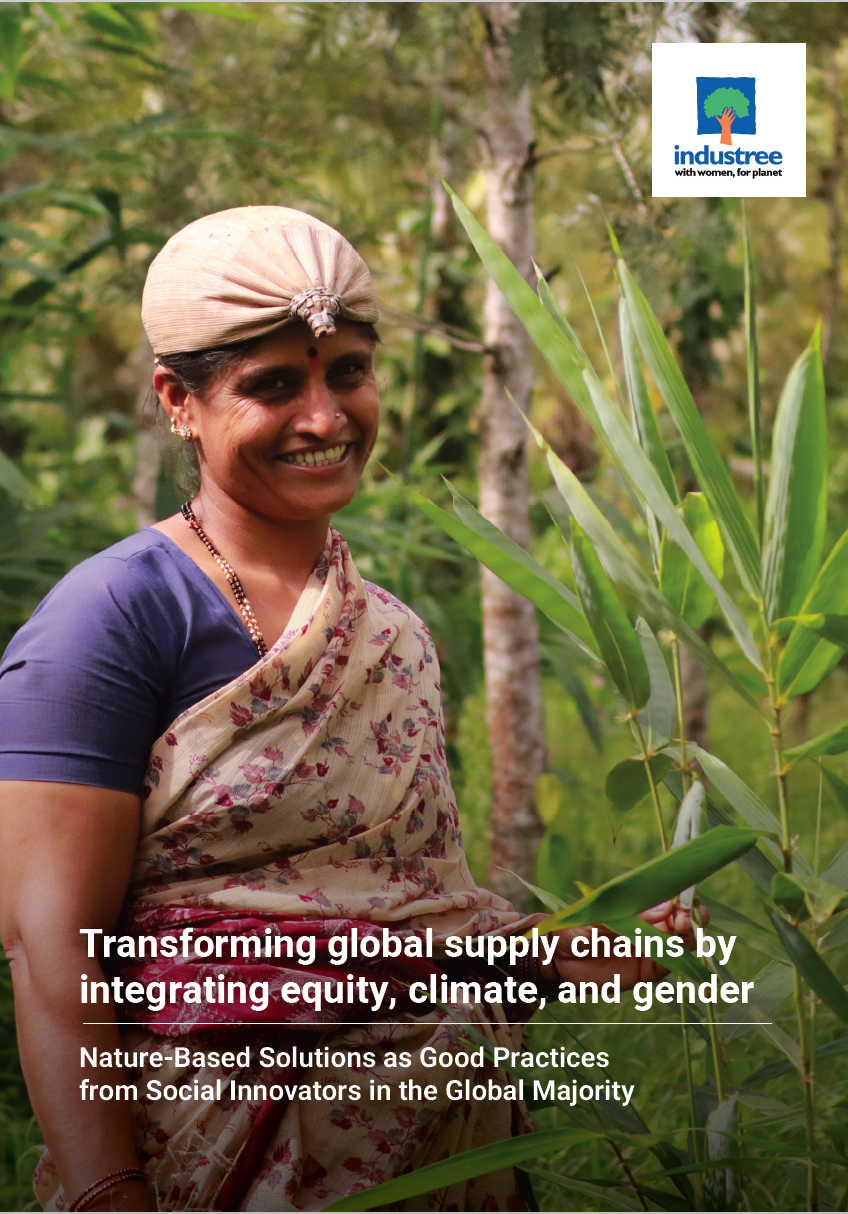
Climate change is disproportionately exacerbating vulnerabilities and risks for the most marginalized stakeholders in agricultural value chains including smallholder farmers, women, and indigenous communities. This position paper is written from the perspective of social innovators, building theory from practice. Our central premise is that nature-based solutions integrating equity, climate, and gender (ECG) as cornerstones can transform global supply chains towards fostering sustainability and enhancing community resilience. We believe that women and other affected communities are best placed to sustain these solutions due to their lived experiences. Key ideas from the paper are outlined below.
Vulnerable communities are disproportionately affected by global supply chain practices and disruptions linked to climate change
- The human and ecological costs of traditional supply chain models in nature-dependent industries are rapidly growing
- Disruptions in agricultural value chains, linked to key developmental priorities such as food security, poverty alleviation, and nature conservation, elicit particularly grave concerns.
- Supply chain disruptions pose direct threats to these priorities, as well as the livelihoods and ecosystems of vulnerable populations who are dependent on natural resources
Global supply chains are linked in a cyclic web with ECG amidst overlapping feedback loops across variables
- The expansion of global supply chains often exploits labor and natural resources, disproportionately impacting marginalized communities, including women
- Global supply chains are major contributors to climate change, primarily through carbon emissions, with eight key supply chains responsible for over 50% of global emissions
- Food, fashion, and fast-moving consumer goods (FMCG) segments in global supply chains are among the worst hit by climate change due to their reliance on nature
A focus on the ECG approach can help transform global supply chains and address cascading challenges
- The ECG approach brings together outcomes linked to socioeconomic equity and justice, climate resilience, and a shift in traditional gender norms to foster change
- The application of this approach can lead to systemic transformation across communities, economies, and the environment
Integrating good practices by social innovators has helped evolve the ECG framework as a reflective tool to inspire field building and positive change
- The ECG framework offers indicators, benchmarks, and reflective prompts under each of the three cornerstones
- The framework’s approach is not evaluative but adaptive, allowing organizations to follow distinctive courses
- Through its application, organizations can identify key stakeholders, set meaningful goals, establish a strategic direction for implementation, and map their progress
Highlighting the distinct journeys of social innovators from the global majority reveals the power and the possibility to transform global supply chains and build sustainable businesses
- Use-cases for the ECG framework span diverse stakeholders that recognize the interconnections between its cornerstones, such as social enterprises, non-profit organizations, and public programs
- India's diversity and population size offer an ideal testing ground for social innovators applying the ECG approach, which can have global scalability
- Across the global majority, social innovators are implementing successful strategies that underscore the feasibility of scaling up the ECG principles on a global scale – the table below illustrates the profiled initiatives
|
Organization
|
Geography
|
Value Chains
|
ECG Strategy
|
|
Industree Foundation
|
India
|
Banana, Bamboo, Sal
|
- Green Supply Chains
- Economic Freedoms
- Women’s Leadership
|
|
Bindi International
|
India
|
Solar energy
|
- Women-Led Green Energy Transitions
- Scaling Solar Energy Use
- Building Climate-Adaptive Capacity
|
|
BRAC
|
Bangladesh
|
Agricultural value chains
|
- Vulnerability-Specific Approach
- Engagement with Women and Youth
- Multistakeholder interventions
|
|
Landesa
|
Global
|
Land as a resource
|
- Building Consciousness
- Challenging Marginalization
- Shaping Resource Management
|
|
Techno Serve’s Mocca Project
|
Central and South America
|
Coffee, Cacao
|
- Augment Research and Dissemination
- Catalytic Funding Model
- Strong Technical Assistance
|
|
Onion Doctor
|
Kenya
|
Onion, Garlic
|
- Building Climate Resilience
- Creating Knowledge-Led Solutions
- Ecosystem Strengthening
|
|
SEKEM
|
Egypt
|
Cotton, Maize, Potato, Wheat, Sugarcane, Rice, SugarBeet
|
- End-to-End Management
- Balancing Trade-offs
- Institutionalizing Practices
|
The strong proof of concept visible in the ECG journeys of social innovators can be scaled through a two-pronged strategy
- Bolstering collaboration and enhancing communication can help tap into the collective expertise, resources, and experiences of various stakeholders
- Infusing innovative fi nance mechanisms can diversify investments, leverage and streamline innovative climate fi nance models, and mitigate risks