

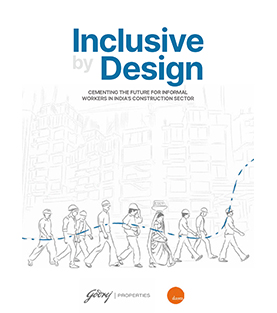
The plight of the informal and migrant workers has remained unnoticed because of systemic barriers and our collective apathy until the pandemic hit us Multi-layered systemic challenges faced by these workers are exacerbated by their intersectional identities The construction sector is one of the largest employers of informal and migrant workers in India, on account of fast-paced urbanization and a high demand for low-skilled workforce. Despite them being responsible for building our homes and cities, it took an unprecedented crisis brought on by the spread of the coronavirus disease (COVID-19), to spotlight the plight of this thus far invisible workforce. The construction sector contributes to ~9% of India’s GDP3. However, the inequalities faced by the vulnerable workers employed in this sector are a stark contrast to its economic progress. While migration is a critical solution to build economic opportunity, it is currently driven by distress. Further, vulnerabilities caused by gendered skill gaps and societal norms result not only in 10 times more men4 as compared to women being employed in the sector, but earnings at levels 30-40%5 lower than their male counterparts, specifically in urban areas.
Key stakeholders featuring at various touchpoints affect construction workers’ experiences through complex journeys
Delving deep into the many journeys of informal migrant workers in the sector, reveals not only the inequities arising from the primary breakpoints impeding their progress, but also how key stakeholders play defining roles in their interactions. The stakeholders are classified under the broad groups of the government, community, contractors, and industry, characterized as their principal employer. Since the phenomenon of migration is closely linked with their journeys – the challenges they face have to be analyzed across source, destination and at systemic levels. It is also important to adopt a gender lens, given the exclusionary practices towards women in the sector. The ‘key breakpoints’ at a glance are:
Cornerstones can establish the foundation for a more inclusive tomorrow
This report profiles change-making non-profit organizations, taking these workers from vulnerability to empowerment: Discussing leading interventions of these non-profit organizations that are changing the story on ground - the report landscapes their work across geographies and programs. Their efforts are laying the foundation to improve outcomes for this workforce.
Industry leaders and the Government should now lead the way towards an inclusive future of work: The need of the hour is holistic transformation, for which it is imperative that all key stakeholder categories play a more catalytic role in bridging identified systemic barriers and promoting greater dignity and equity for informal workers in the construction sector. As the government plays its part in effectively safeguarding workers’ rights and easing access to entitlements, business leaders must take the first step to reset aspirations towards inclusive workforce participation and growth. Industry associations and similar influential stakeholders must play a supporting role too, by championing the cause of worker well-being to create a level playing field for responsible businesses, to ensure that they survive as successful businesses. Non-profit organizations can provide critical impetus to this movement through their ground-up insights and trusted networks, while philanthropists can offer risk capital and push for innovations that build missing bridges and address the most distressed communities, providing labour to the sector.

 Thought Leadership
Strategic Philanthropy
 Playbooks & Toolkits
Strategic Philanthropy
 Thought Leadership
Strategic Philanthropy



Explore 25+ years of Dasra's research and knowledge products, covering underserved sectors, philanthropy trends, and civil society action across India.