

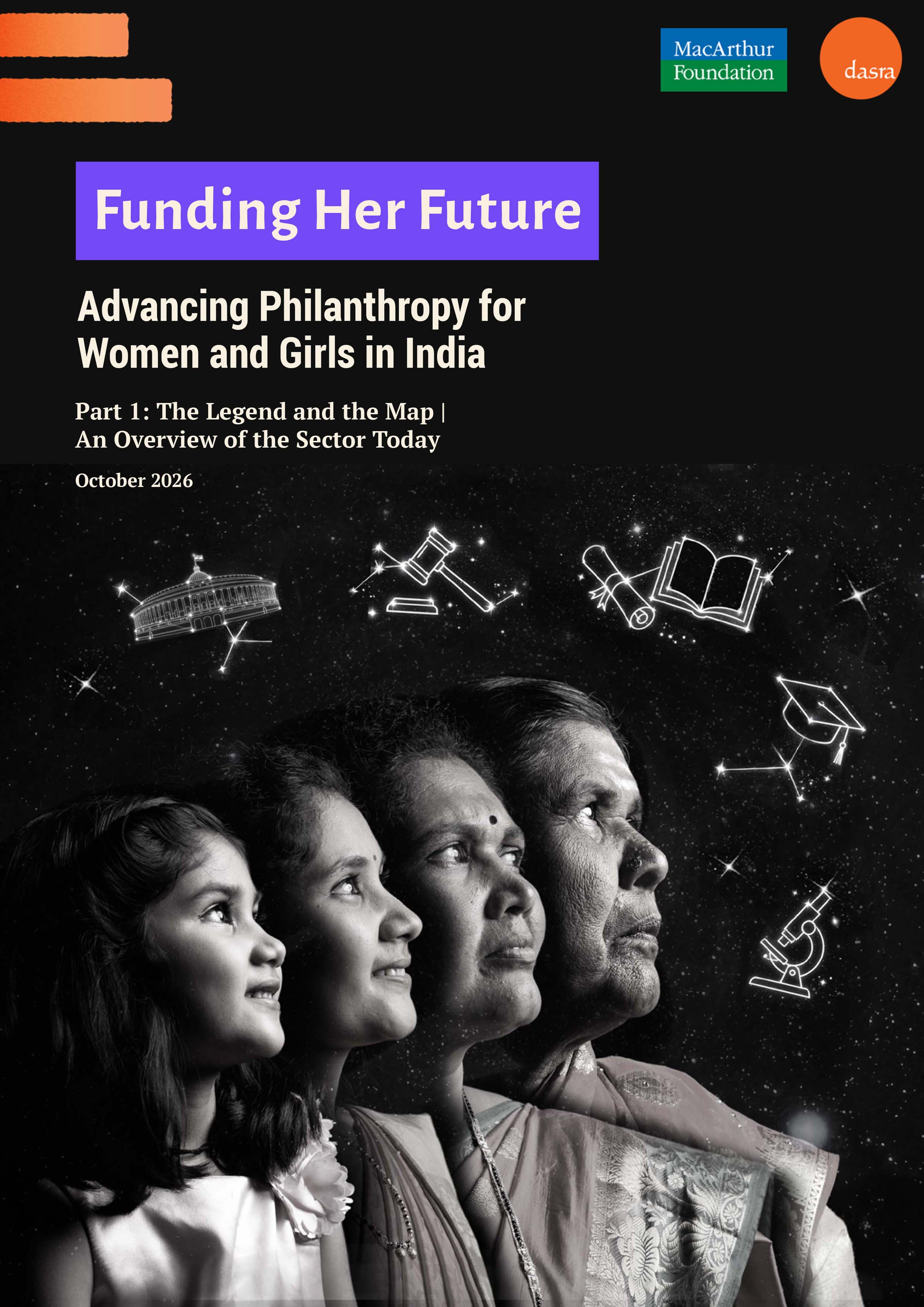
Explore the findings from this report in a narrative and interactive format on the Funding Her Future Microsite at https://www.fundingherfuture.in/.
India has made remarkable progress for women and girls over three decades. Child marriage has nearly halved, female literacy has risen from 39% to over 70%, and more than 100 million women belong to self-help groups. Decades of sustained government investment in education, health, social protection, livelihoods, and financial inclusion, creating opportunities for millions for whom these opportunities were previously out of reach. And a civil society and philanthropic sector that undertook the last-mile work to strengthen livelihoods, expand financial access, and shift norms community by community. But this progress has not been even, and it is not guaranteed.
Much is known about how the lives of women and girls have changed in India. Far less is understood about the civil society and philanthropic ecosystem that helps make that change possible. Part 1 of Funding Her Future asks: Which organizations receive funding? Which struggle to access it? What influences funder decisions? Where are resources concentrated? And where do critical gaps remain?
Drawing on a survey of 169 organizations working with and for women and girls, alongside 38 interviews with nonprofit leaders and ecosystem actors, Funding Her Future explores what investing in women and girls looks like, with a focus on philanthropy and civil society action. It is an invitation to think differently and suggests that the returns are intergenerational and measurable.
What emerges is a sector doing remarkable work on thin margins. 2/3rds of surveyed organizations are small or micro, most led by people from the very communities they serve, and the average one reaches about 18,000 people a year on roughly INR 1.6 crore. Yet 63% of the reported budget is concentrated in the top 5% organizations, and those led by marginalized communities receive about a third less than the average organization. The deepest work is done by the smallest organizations: about 68% of micro-organizations work on preventing gender-based violence, which is high-touch, context-specific work that relies on sustained community trust, while 61% of large and very large NGOs focus on skilling and livelihoods, which are easier to scale and measure. Meanwhile, 70% hold no reserves; only 4% are financially stable, and many bridge gaps through founder loans and delayed salaries. The deeper the work goes into creating long-term change and building agency, the narrower the funding base becomes.
The opportunity is to fund the organizations that help women realize their tremendous potential: backing violence prevention, building women's leadership through existing platforms, and making livelihood, health, and education funding explicitly gender-focused, with patient, flexible capital. Funding the future of women and girls is one of the smartest investments India can make, and it begins with trusting the organizations closest to them to lead.
 Research Reports
Gender Empowerment, Strategic Philanthropy
 Research Reports
Gender Empowerment, Strategic Philanthropy



Explore 25+ years of Dasra's research and knowledge products, covering underserved sectors, philanthropy trends, and civil society action across India.