

This report has been designed to be accessible. For any questions or accessibility-related support, please contact cprein@dasra.org
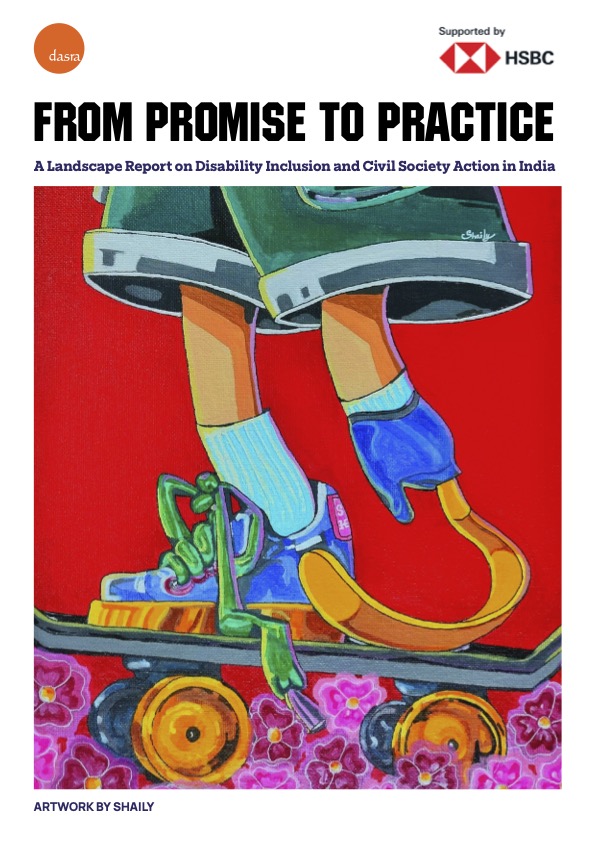
Disability is often made to appear as something contained within the body or the mind: an impairment, a limitation, a difference to be named and managed. But exclusion is produced in the world around it — in institutions, infrastructures, and norms that decide whose needs are built in, and whose are treated as exceptions. In India, this reality now sits alongside a stronger legal and policy framework. The RPwD Act, 2016, expanded disability categories, and recent judicial decisions affirming accessibility, including digital access, have widened the legal language of equality, dignity, and participation. Yet, for an estimated 40–90 million persons with disabilities, the distance between legal recognition and lived reality remains wide.
Across education, employment, healthcare, public infrastructure, and civic life, access is uneven, fragmented, and contingent on individual navigation rather than institutional readiness. These exclusions are not incidental. They shape autonomy, participation, household resilience, and economic life, with workforce non-participation by persons with disabilities estimated to cost India 3–7% of GDP annually. Disability exclusion reveals how systems are built: whose needs are anticipated, whose are treated as exceptions, and who is left negotiating for entry.
The nonprofit sector occupies a structurally unusual position in the disability ecosystem. It sits between the state, the market, the family, and the community, translating across fragmented or siloed systems, which have been formally claimed but practically underdelivered.
Data from 109 disability-focused nonprofits reveals a sector that is mature, adaptive, and chronically stretched:
Organizations routinely work across multiple domains like education, health, livelihoods, early intervention because lived needs do not align with institutional silos. The outcome leads to a structural inversion: those closest to need are also those least resourced to absorb its complexity. Over time, responsibility settles with nonprofits, while systems meant to carry that responsibility remain underdeveloped.
Disability exclusion cuts across education, employment, health, legal and civic life, and social participation. Across these domains, exclusion appears as repeating pathways, from school dropout to workforce exclusion, from fragmented care to limited public participation. These pathways are shaped at multiple levels: visible events, recurring patterns, underlying structures, and mental models. As a result, exclusion is reproduced through physical inaccessibility, along with assumptions about productivity, independence, and whose participation is considered necessary.
Nonprofit efforts are concentrated in more fundable domains: education (63%), livelihoods (48%), early intervention (42%), and healthcare (40%). Work that addresses deeper conditions — research (8%), legal access (7%), narrative change (7%), accessibility (6%), and caregiver support (8%) — remains thinly resourced. CSR spending on disability-linked categories accounts for just 1% of total CSR expenditure, with only 4% of companies contributing at all. State funding remains the primary source, with INR 1,670 crore allocated to the Department of Empowerment of Persons with Disabilities in FY 2026–27. Recent increases are concentrated in scheme-based spending, particularly in skilling and assistive devices.
The structure of funding shapes what the ecosystem can sustain. Work that fits within clear mandates is easier to fund than work that requires coordination, long-term investment, or system-level change. The current funding architecture shows underinvestment in core, connective, and field-building functions — the very elements required for long-term system change.
The report closes by identifying five cornerstones that can help move disability inclusion from fragmented effort to durable systems change. These priorities are not standalone recommendations; they are shared conditions for action across government, philanthropy, industry, and civil society.

 Thought Leadership
Strategic Philanthropy
 Playbooks & Toolkits
Strategic Philanthropy
 Thought Leadership
Strategic Philanthropy



Explore 25+ years of Dasra's research and knowledge products, covering underserved sectors, philanthropy trends, and civil society action across India.