

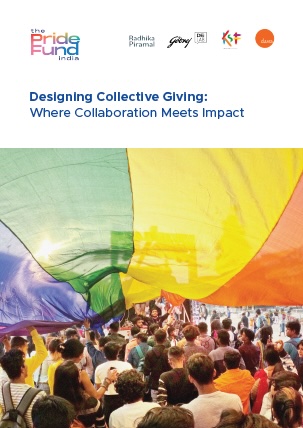
India’s LGBTQIA+ movement has become considerably more visible over the past decade, shaped by legal change, corporate leadership and a widening public conversation around sexual orientation and gender identity. Yet greater visibility has not been matched by the institutional and philanthropic infrastructure needed to sustain progress. LGBTQIA+ organizations—particularly grassroots and community-led groups working across mental health, livelihoods, housing, safety and rights—continue to operate with limited and uncertain resources. The result is a persistent gap between recognition of LGBTQIA+ communities and the capacity of organizations serving them to build resilient institutions and plan for the long term.
Pride Fund India (PFI) emerged in response to this gap. Launched in February 2025, the Fund brought together an individual philanthropist, a family foundation and corporate philanthropy within a shared platform anchored by Dasra. Its premise was that addressing an under-resourced and fragmented field required more than increasing the quantum of funding: it required giving differently. Pooling capital could distribute risk, create greater predictability for organizations and lower barriers for new donors, while an intermediary could provide the governance, due diligence and operational infrastructure required to translate collective intent into credible action.
PFI’s early experience demonstrates what this approach can enable. Research mapped 81 registered LGBTQIA+ nonprofits and surfaced an ecosystem that was geographically concentrated, uneven in organizational capacity and constrained by compliance and funding barriers. These findings informed a grantmaking model designed around flexibility and organizational diversity rather than a uniform definition of readiness. Within its first nine months, PFI expanded from eight to 17 grantee organizations, while funds raised grew from approximately INR 18 million to INR 32.3 million. Alongside capital, the Fund began investing in collective capacity-building and peer learning, signalling an evolution from grantmaking mechanism towards ecosystem platform.
The experience also offers lessons beyond LGBTQIA+ philanthropy. Collaborative funds are most effective when they begin with the field rather than the funding vehicle; allow community realities to shape grant design; distribute decision-making power deliberately; balance trust with accountability; accommodate uneven organizational capacity; and build learning and adaptation into their architecture.
PFI therefore represents not a finished model, but an evolving case in how collective philanthropy can help build the conditions for a field to become stronger. Its experience suggests that for overlooked causes, durable impact depends not only on mobilizing more capital, but on strengthening the relationships, institutions, knowledge and infrastructure through which that capital can translate into sustained change.

 Thought Leadership
Strategic Philanthropy
 Playbooks & Toolkits
Strategic Philanthropy
 Thought Leadership
Strategic Philanthropy



Explore 25+ years of Dasra's research and knowledge products, covering underserved sectors, philanthropy trends, and civil society action across India.