

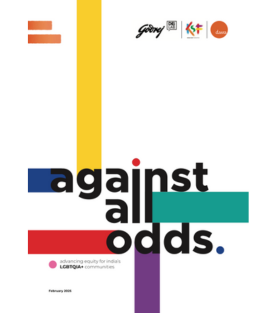
India’s journey toward LGBTQIA+ equity is often narrated through legal milestones. The 2014 NALSA judgment affirmed the right to self-identify one’s gender. The reading down of Section 377 in 2018 marked a historic repudiation of criminalization. These moments matter deeply; they signal shifts in constitutional imagination and public discourse. Yet, for millions of queer individuals across India, the distance between legal recognition and lived dignity remains vast.
Queer lived experiences in India are profoundly shaped by intersecting realities of caste, class, religion, tribe affiliation, geography, disability, and gender identity. Across this diversity, exclusion is rarely singular. It is experienced through overlapping systems of economic precarity, institutional discrimination, social isolation, and heightened vulnerability to violence. While public conversations around queer rights have grown louder, mainstream development discourse continues to render these communities peripheral, often treating inclusion as symbolic rather than structural.
This report reveals that the real architecture of progress has been built not solely through landmark judgments, but through the sustained and often under-recognized work of civil society organizations. Across the country, LGBTQIA+-focused CSOs have emerged as the connective tissue between legal aspiration and everyday survival, building systems of care, advocacy, and solidarity where formal institutions have fallen short.
The findings point to a landscape shaped by both possibility and constraint.
India’s policy environment remains largely judiciary-led. Courts have affirmed foundational rights to dignity, privacy, equality, and self-expression, while also expanding recognition of queer relationships and gender identity. Yet legislative and executive action has been uneven and incomplete. Formal legal protections remain fragmented, and critical questions of marriage, family recognition, inheritance, and social security remain unresolved. This policy inertia is inseparable from political invisibility. The absence of reliable population-level data, coupled with limited queer political representation, has meant that LGBTQIA+ communities are rarely recognized as a distinct policy constituency.
In this vacuum, civil society has stepped in to build what institutions have not. More than half of the organizations mapped in this report work as service providers and field-builders, delivering critical interventions across healthcare, education, livelihoods, shelter, and access to justice. Many operate hyperlocally, deeply embedded within communities and responsive to contexts often overlooked by national systems.
Equally significant is who is leading this work. The report finds that queer-led organizations form the backbone of the ecosystem. Their leadership reflects a powerful shift toward community-rooted models of change, where interventions are shaped by lived experience rather than external assumptions. This is not only a question of representation; it is a strategic imperative. Investing in queer-led institutions strengthens long-term resilience, nurtures future leadership, and ensures solutions remain grounded in authenticity.
Yet these organizations remain structurally under-resourced. Funding for LGBTQIA+ issues in India is disproportionately reliant on international philanthropy, even as India receives only a fraction of global queer funding. Domestic philanthropic participation remains limited, and many grassroots organizations are ineligible to receive foreign contributions. The result is a profound mismatch between need and resourcing.
The report identifies four critical cornerstones for strengthening the ecosystem: universalizing LGBTQIA+-affirming documentation and legal recognition; investing in community-led crisis response infrastructure; enabling greater visibility through culture and public life; and generating rigorous, community-sensitive evidence to inform policy and programming. These are not isolated interventions. Together, they create the enabling conditions through which dignity becomes materially accessible.
The larger takeaway is clear: queer equity cannot be achieved through legal reform alone. It demands long-term investment in the civic infrastructure that allows rights to be exercised, protected, and lived.
India’s LGBTQIA+ movement has shown extraordinary resilience, sustained by organizations and leaders who continue to imagine possibility despite systemic neglect. The question now is whether philanthropy, government, media, and institutions will move beyond performative inclusion toward structural commitment. Because real progress lies not merely in recognizing queer identities, but in building a society where they can flourish fully, visibly, and without compromise.

 Thought Leadership
Strategic Philanthropy
 Playbooks & Toolkits
Strategic Philanthropy
 Thought Leadership
Strategic Philanthropy



Explore 25+ years of Dasra's research and knowledge products, covering underserved sectors, philanthropy trends, and civil society action across India.